- The Venture Catalyst
- Posts
- Tech Titans and Corporate Lessons
Tech Titans and Corporate Lessons

The Venture Catalyst
September 20, 2024
MARKET BUZZ
BRIEFING BOARD

Creator: Chip Somodevilla | Credit: Getty Images
🏦 The US Federal Reserve has made its first interest rate cut in 4 years. The reduction of 50 basis points comes as a much-needed antidote for lowering borrowing costs and alleviating the job market. The move emphasizes the Fed's commitment to address the rising unemployment level that's projected to reach 4.4% by the end of the year. For other countries, this rate cut has significant implications. A weaker US dollar, which often follows Fed rate cuts, can lower the cost of repaying dollar-denominated debts, benefiting a lot of developing countries. Although past rate cut cycles (in 2000 and 2008) could offer some insights, the overall outcome tends to be less predictable when compared to today's global economy, that is still recovering from the lingering pandemic effects.
🤖 OpenAI releases o1, its first model with ‘reasoning' abilities. OpenAI has released o1 and o1-mini, the first in a series of reasoning models that have been trained to answer more complex questions faster than a human can. The model is better at writing code and solving multistep problems than previous models, but it is more expensive for developers and slower to use than GPT-4o. The release is still in preview to indicate how nascent it is. ChatGPT Plus and Team users should already have access to the model, while Enterprise and Edu users will get access early next week. OpenAI plans to bring o1-mini access to all free users, but it hasn't set a release date yet.
🧑💼Y Combinator is expanding! For the uninitiated, Y Combinator is the renowned startup accelerator behind companies like Airbnb and Stripe. By taking four cohorts a year, with each cohort lasting 11 weeks, the company will now operate almost year-round. Its President, Garry Tan, aims to better respond to founders by offering funding right when they start and providing more in-person Demo Days, where startups pitch to top investors. This schedule, set for 2025, is believed to increase the program's responsiveness while retaining its exclusivity. Due to this change, though the cohort size has been halved, the total number of startups will remain around 500 annually. These changes are an attempt to change YC's future after it closed its $700 million Continuity Fund, which invested in the top YC startups. At the moment, each YC company continues to receive a $500,000 investment, including $125,000 for a 7% stake and $375,000 for future rounds.
💻 Intel's situation is not looking good. Since August 1st, the company has faced a severe backlash, reporting poor financial results, with sales dropping by 1% YOY and a net loss of $1.6bn. CEO Pat Gelsinger emphasized issues of high costs and low margins, prompting the tech giant to cut 15,000 jobs and suspend dividends, leading to a 50% drop in its share price over the last two quarters. Despite receiving backing from the Biden administration, the company continues to lag behind competitors like Nvidia and TSMC. Within the AI chip market, Intel's $500m quarterly sales look meager compared to Nvidia's $20bn. Intel now plans to invest $100 bn in expanding its manufacturing plants, securing funds from private investors like Brookfield and Apollo, including the billions it has received in government aid.
CORPORATE MISSTEPS
YOUR FAVORITE SHOE BRAND FACES ALLEGATIONS, AGAIN
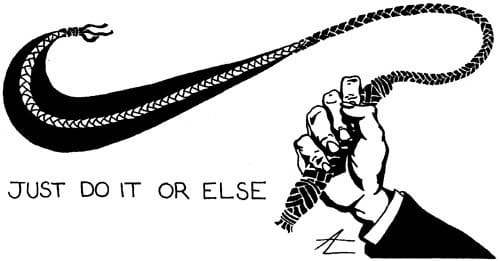
Illustration: libcom.org
Nike, a global athleisure wear giant known by the vast majority of the population for its performance apparel and endorsements by sports legends, has been facing serious allegations, particularly relating to unpaid wages to factory workers and a toxic workplace environment. Nike has faced such allegations before, such as in 1992, when a report surfaced revealing that it was using sweatshops and abusing workers in East Asia. The report also showed that the workers in the supply chain were being paid as little as 14 cents per hour, making it difficult for the workers to even cover their basic costs. This led to public anger and mass protests at the Barcelona Olympics.
In 2024, Nike has been accused by a group of 70 investors and more than 50 human rights groups of failing to compensate over 4,000 workers in its supply chain in Thailand and Cambodia. The first claim involved workers from the Violet Apparel factory in Cambodia, which closed in July 2020 without paying $1.4m in legally owed wages and benefits. Additionally, Nike is accused of an illegal “wage theft” scheme at the Hong Seng Knitting factory in Thailand in 2020, reportedly depriving Burmese migrant workers of nearly $0.6m in wages, now amounting to $0.8m with interest.
Apart from labour and wage issues abroad, Nike is being criticized for fostering a toxic work culture. A former employee of Nike, Pam Parker, has alleged that the company has a toxic culture and is a “boys’ club.” Parker’s claims include seeing prostitutes on work trips and witnessing human resources efforts to protect top executives. On conducting an internal investigation named Project Starfish, it was found that there were widespread instances of bullying, harassment, and a culture of intimidation, particularly affecting female employees. Nike’s response to these allegations was criticized as being insufficient; activists claimed that the company was deflecting from its responsibility and not taking accountability for their actions. Many have urged Nike to establish mechanisms for protecting workers’ rights and preventing this situation from occurring again.
This incident sheds light on the broader issue that has been plaguing the fashion and apparel industry for a long time now, wherein low-wage countries like Bangladesh, Cambodia, and Vietnam have to face the negative consequences of the cost-cutting measures of big MNCs like Nike. Over time, consumers are becoming more conscious of where their products come from, and incidents like the one stated above will likely affect the reputation and image of the brands involved in such controversies.
CASE IN POINT
APPLE: BEYOND A SUPPLY GLITCH
Creator: ALY SONG | Credit: REUTERS
INTRODUCTION:
Apple Inc. founded in 1976 By Steve Jobs, Steve Wozniak, Ronald Wayne and headquartered in the Silicon Valley, is an American Multinational Company that is best known for its consumer electronics, software and services. They gained prominence by revolutionising the tech industry by introducing the iPod and the iPhone (the latter went on to be the most popular and valuable product of Apple, contributing a major proportion to company’s total revenue.) While Apple has been a benchmark for innovation and robust supply chain with successful product line-up of hardware including the Mac, Vision Pro, Apple Watch, services and software alike, a few years back it faced a significant supply chain and logistical challenge.
CHALLENGE:
The COVID-19 period was a tumultuous one for the company as it brought about global disruptions in supply chain and logistics in the form of Factory Shutdowns, Component Shortages, Demand Fluctuations and Product Availability. Several of Apple’s manufacturing partners and suppliers were forced to temporarily halt their operations due to government-imposed lockdowns, especially in China which delayed product availability due to postponed production schedules. Coupled with the production halt and supply chain bottlenecks, was a shortage in supply of critical components and raw materials which further deterred production of electronics at a time when its demand was high due to remote work and learning conditions. Sales forecasts and inventory management was further complicated by a host of transportation and shipping delays.
SOLUTION:
Mitigating the disruptions brought about by COVID-19 became the company’s foremost priority which it accomplished through multiple means. Firstly, Apple undertook diversification of its suppliers by extending its network beyond China to the nations of India and Vietnam. It helped reduce the high dependency on Chinese manufacturers while aligning the company with its strategy of spreading risk across multiple geographies. To ensure stability in supply of critical components and enabling better negotiations during shortages, Apple chose to strengthen its relationship with key suppliers by establishing long term contracts and better financial incentives. They expanded production capacity by offering funds and technical support to their suppliers in raising output and minimising bottlenecks while investing in advanced supply chain management technologies that enhance the use of AI and machine learning to optimise inventory levels, accurately forecast demand, anticipates and responds to potential logistical disruptions.
RESULT:
The measures undertaken helped Apple avoid incurrence of sustained losses, regain a dominant position within the consumer electronics industry and bring about continuity in product management and availability.
EXPERT EDGE
CORRELATION IN FINANCE: IMPACT AND APPLICATIONS

Creator: monsitj | Credit: Getty Images
In the complex world of financial analytics, understanding the relationships between variables is crucial for making informed decisions. One fundamental statistical tool that helps in this regard is correlation. But what exactly is correlation, and how can it be leveraged to identify and interpret financial trends?.
Correlation measures the extent to which two variables move together or influence each other's behavior. In finance,correlation can measure the movement of a stock in accordance with an index such as the NIFTY 50.
Types:
Positive Correlation (+1): It indicates a proportional relationship between two variables.
Negative Correlation (-1): It indicates an inversely proportional relationship between two variables.
No Correlation (0): Implies no linear relationship between the variables.
It's important to note that correlation does not imply causation; it merely indicates a relationship, not that one variable causes the other to change.
Correlation demonstrates the strength of a relationship between two values.Correlation can be calculated in the same asset class or between asset classes.
Companies in the same industry will correlate strongly during sector-wide turmoil such as monetary policy adjustments, or macroeconomic shifts for e.g. TCS and Infosys have a positive correlation in the stock market. Certain large-cap stocks lend themselves to correlation through fund flow(By being part of the same index and being included simultaneously in index fund investments).
A low correlation between your investments across different asset classes ensures that when one asset class experiences volatility or decline, the others remain unaffected or may even perform well, thereby reducing the portfolio's overall risk. Eg:Traditional negative correlation between gold prices and US stock index performance.However, a shift in correlation is always possible, so investment decisions should not be based solely on low correlation.
In conclusion, correlation serves as a vital analytical tool in the realm of financial analytics, enabling investors and analysts to understand the relationships between various financial variables.Investors can leverage positive and negative correlations to optimise their portfolios, ensuring that they are well-diversified and resilient against market fluctuations. By quantifying the degree to which two variables move in relation to each other, correlation provides insights that are essential for effective portfolio management, risk assessment, and trend identification.